
Unknown
Item set
Stories
The Hurricane Helene Archive brings together a collection of media contributed by community members, researchers, and historians. Use this page to explore firsthand accounts, images, and documents that offer insight into the storm, its impacts, and recovery efforts.
- 📖 Show Search Tutorial
-
- View a Story: Click on a story to open it up and view its details and media.
- Sort the Archive: Click Sort to arrange stories by creation date or alphabetical order.
- Advanced Search: Click Advanced Search to narrow results by various dimension options.
Do you have a story or item to add? Contribute Your Story
Feel free to share the archive.
-
Poem for An Act of God: Hurricane in the Mountains
 UnknownI’m beginning to fear that Back in the coves and hollows And down by the creeks and rivers That nurtured us, Gave us commerce and roots, The mountains are full of death— Deer and squirrels and cattle, Soft slopes of loam That clung to the mountainsides, The rich fields that lay Along the rivers, And people. The silent dead Wait patiently To be found Among the hemlocks And the rhododendrons. --Diane Blanks Watauga County, NC October 2, 2024
 -
Helene
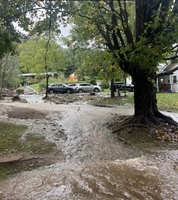 UnknownI went to sleep that night thinking it was a normal storm in Appalachia. When I woke up the next morning I went downstairs to look out our window and see a river running through my front yard. Our house is directly at the end of a mountain runoff ditch that I’ve only ever seen a small stream of water roll through. This day it was an angry river carrying large rocks and debris from the top of the mountain all the way down king street. We tried to walk through our gravel driveway with water up to our thighs, rocks hitting our legs underneath. When the storm passed, we walked down king street, I felt like I didn’t know where I was even though I’ve lived here 3 years. Everything was covered in mud and there were peoples personal items strewed out on the roads and in ditches. I am grateful to be a part of a community as strong as Appalachia.
 -
Tara
 UnknownTara
 -
Sunnee FreedUnknownSunnee Freed
-
Rev. Kathy Beach and Rev. Andrew HegeUnknownRev. Kathy Beach and Rev. Andrew Hege
-
Hospitality House Response to Hurricane HeleneUnknownTina Krause (Executive Director and Northwest Continuum of Care lead for seven counties), Todd Carter (Chief Development Director), and Tom Reutler (Disaster Recovery Housing Navigator) from Hospitality House in Boone describe their experiences during Hurricane Helene. Planning intensified on Wednesday as they coordinated with agencies across seven counties to bring vulnerable people to shelter early—two van loads came from Wilkes County, and disabled clients living near water were evacuated preemptively. Thursday evening, Tina faced a difficult decision: stay on-site knowing she'd be there for days, or go to her home near the New River which she knew would flood without her there to fight the water. She drove home, barely making it across the bridge as water already lapped over it, and spent the night stacking rubber floor mats and bags to divert water from her doorways. She was trapped for three days while her road collapsed and every house along it went underwater. Meanwhile, she couldn't reach her family in Warrensville where there'd been a mudslide. Tom had severely underestimated the storm's impact and arrived at work to find trailers and cars across the street completely underwater—"a historic disaster." He could only occasionally reach Tina by walking to the top of the hill, managing to say a sentence or two before getting cut off. Todd watched from his apartment as Highway 421 became a lake, trying unsuccessfully to reach emergency personnel to block the road as people kept driving through and getting stuck—authorities had run out of barriers. Hardin Creek quadrupled in size, taking out a giant chunk of land behind his building. Before they could even assess their main facility, they faced a terrifying crisis with disabled clients stranded in apartments around town—some woke up floating as water came into their units in the dark. One client climbed to her roof and begged Tina over a patched phone call, "I can't swim, I can't swim," taking eight hours to rescue by boat. Others with mental health issues and PTSD refused to leave, forcing the fire department to make the hard decision to abandon them there. When Tina finally reached the facility after three days, they met in the dark on wet floors (now hardwood) to assess damage and locate staff—over a third were displaced. With 150 people sheltered at the Brookhollow complex and communication down, they desperately needed a generator for this building to function. The main facility's large generator helped them manage, though they had significant damage to both buildings. An overwhelming smell of gas caused panic until their facilities specialist David identified it as coming from a giant propane tank that had separated from Republic Waste Management next door and was spewing gas into the air. With nowhere to evacuate 150 people—water on one side, debris fields on the other—they had to stay despite the danger. Firefighters brought people from flooded homes across the street by boat, many not speaking English. Restaurants brought prepared meals as they were about to lose food. Tina emphasized to HUD officials that when disaster strikes, asking "what do you need" must mean right now—they needed refrigeration, storage units, plumbing. A friend from Greensboro sent a shower truck (labeled "hazardous shower" for chemical spills) within hours. The town was under boil water advisory while serving hundreds. They dispatched supplies to Bradford trailer homes, rescued a client in a wheelchair stuck outside Coyote Kitchen under two feet of mud, and helped an Iraq/Afghanistan veteran with PTSD whose medications washed away and who was on the verge of a breakdown. Tina and Todd worked 48 straight days without a day off at this table, wearing overalls and boots for two months. They've since installed permanent generators at all facilities, diversified phone carriers, and advocated for satellite phones as eligible expenses for facilities housing this many disabled people. The fire chief told town council that if it had rained 45 more minutes, he'd be reporting a mass casualty event.
-
Ashley GalleherUnknownAshley Galleher
-
Messages of Hope: Ep 4 - Lansing, NC's Comeback
 UnknownWith the support of UNC Health Appalachian, the Boone Area Chamber of Commerce presents Messages of Hope. This series features stories of the perseverance, courage, and partnerships displayed in the wake of Hurricane Helene's impact on the North Carolina High Country. Join Lansing, NC duo, Mayor Mack and Brittany Duncan, as they stroll through their vibrant downtown nearly one year after Hurricane Helene. Along the way, they visit business owners and gathering places, highlighting how each has progressed over the past year. This spirited community is welcoming, ready for business, and looking firmly ahead. Produced by Real Boone Studios with support from the Boone Area Chamber of Commerce.
 -
Messages of Hope: Ep 3 - Cornerstone Summit
 UnknownWith the support of UNC Health Appalachian, the Boone Area Chamber of Commerce presents Messages of Hope. This series features stories of the perseverance, courage, and partnerships displayed in the wake of Hurricane Helene's impact on the North Carolina High Country. As we approach the one-year milestone of Hurricane Helene, we reflect on what has powered us through the past year: relationships. In this third episode, join Pastor Reggie Hunt as we travel into the hard-to-reach corners of the High Country, where strong networks carried neighbors through recovery. Cornerstone Summit became a hub for resources, supplies, and most importantly, togetherness. We’re reminded that a church is more than a building - it’s the people and their service who embody it. Produced by Real Boone Studios with support from the Boone Area Chamber of Commerce.
 -
Messages of Hope: Ep 2 - The Resilient People of Beech Mountain
 UnknownWith the support of UNC Health Appalachian, the Boone Area Chamber of Commerce presents Messages of Hope. This series features stories of the perseverance, courage, and partnerships displayed in the wake of Hurricane Helene's impact on the North Carolina High Country. In our second episode, we journey to Beech Mountain and see how local businesses, government, and people came together after Helene. These leaders rallied to ensure the community had essential supplies while others built the literal road to recovery. In the face of isolation, these leaders turned a challenging situation into a testament of resilience and community spirit. Produced by Real Boone Studios with support from the Boone Area Chamber of Commerce. Additional footage provided by Jimmie Accardi, Talia Freeman, and Town of Beech Mountain.
 -
Messages of Hope: Ep 1 - Valle Crucis School
 UnknownWith the support of UNC Health Appalachian, the Boone Area Chamber of Commerce presents Messages of Hope. This series features stories of the perseverance, courage, and partnerships displayed in the wake of Hurricane Helene's impact on the North Carolina High Country. In our first episode, we hear the story of flooding at Valle Crucis Elementary school, and how local partners came together to provide a home for over 250 students and staff that were displaced from one of Watauga County's oldest and most cherished locations. Produced by Real Boone Studios with support from the Boone Area Chamber of Commerce. Additional footage provided by Watauga County Schools and Jason Cornett.
 -
One Year After Helene Part 4 - Resiliency: Mountain Strong
 UnknownPart four of a four-part video series created by University Communications around the 1st year anniversary of Hurricane Helene.
 -
One Year After Helene Part 3- Research: Learning From Disaster
 UnknownPart three of a four-part video series created by University Communications around the 1st year anniversary of Hurricane Helene.
 -
One Year After Helene Part 2- Resources: We Are Better Together
 UnknownPart two of a four-part video series created by University Communications around the 1st year anniversary of Hurricane Helene.
 -
Response and Recovery: The First Days of Helene
 UnknownPart one of a four-part video series created by University Communications around the 1st year anniversary of Hurricane Helene.
 -
Stacey Miller BRAHM Listening Day - September 20,2025UnknownThis oral history interview features Stacey Miller, Chief Building Inspector for the Town of Boone, North Carolina, recorded on September 20, 2025, at the Blowing Rock Art and History Museum. As a Level 3 inspector in all five building trades—one of only 5% of inspectors in North Carolina with this distinction—Miller provides a detailed firsthand account of the extensive damage assessment work conducted in the aftermath of Hurricane Helene. Miller describes the storm's impact beginning Thursday before the hurricane hit, through the immediate aftermath when he was called to condemn buildings, and his subsequent three weeks of intensive damage assessment work. His account covers multiple affected areas including the Town of Boone, Watauga County (particularly the devastated Howard's Creek and Watauga River areas), and Ashe County's Lansing region. The interview documents catastrophic flooding, complete destruction of homes and infrastructure, dramatic rescues, and the resilience of affected residents. Miller's professional perspective offers valuable insight into the scope of structural damage, emergency response coordination, and the challenges of post-disaster assessment work across multiple counties in western North Carolina.
-
Robin Miller - Part of Oral Histories collected at BRAHM on Sept 20, 2025UnknownThis oral history interview features Robin Miller, President and CEO of the Blowing Rock Chamber of Commerce, recorded on September 20, 2025, at the Blowing Rock Art and History Museum. Miller offers a unique dual perspective on Hurricane Helene, having experienced the storm's impact in two very different locations. Miller was serving as CEO of the Tampa Bay Beaches Chamber of Commerce in Pinellas County, Florida, when Helene made a near-direct hit on the Gulf Coast community where she lived. As one of the first community leaders to arrive in the aftermath, she was deeply involved in the initial recovery efforts there. She had interviewed for the Blowing Rock position in August 2024, and despite assuming the job search would be suspended due to the hurricane, was offered the position in mid-October while still managing Helene and Hurricane Milton recovery efforts in Florida. She relocated to North Carolina on December 28th, 2024. The interview provides valuable comparative insights between hurricane recovery in coastal Florida versus the North Carolina mountains. Miller contrasts the immediate, rapid cleanup efforts in Florida's tourism-focused communities with the longer-lasting, more interconnected community response in Watauga County. She discusses Blowing Rock's unique situation—experiencing primarily fiscal rather than structural damage due to tourism loss and Blue Ridge Parkway closures—and the ongoing partnership efforts between Blowing Rock and Boone to support affected businesses. Miller reflects on the challenges of experiencing the same disaster in two different communities and her perspective on crisis recovery and community resilience.
-
Renata Dos Santos - BRAHM - Listening Day Sept 20, 2025UnknownThis oral history interview features Renata Dos Santos, co-owner of Rivergill Fishing Company, recorded on September 20, 2025, at the Blowing Rock Art and History Museum. Dos Santos, who has lived in Todd, North Carolina for approximately 12 years, provides a compelling account of Hurricane Helene's impact on her tourism-based outfitting business and the Todd community. Living off-grid at nearly 4,000 feet elevation with her wife Kelly, who served as chief EMT for the Todd Volunteer Fire Department, Dos Santos initially experienced the storm as relatively mild from their home—watching trees sway while drinking hot chocolate. However, the severity became clear when firefighters reported that their 40-foot warehouse containing all their business equipment was gone. The interview describes their difficult journey to assess the damage, the relief of finding their main building (the old train depot) and their animals (a pig and a blind goat) safe, and the shock of discovering their equipment scattered throughout downtown Todd. Dos Santos offers unique insights into the communication challenges and community response, describing how she and Kelly spent hours each night answering messages via multiple platforms, serving as a communication hub for the area due to their elevated location's cell signal. The interview details the massive volunteer response from across the country, the collection of 88,000 pounds of debris, and numerous acts of kindness, including a stranger paying their entire $20,000 trash bill. Notably, Dos Santos shares the profound emotional impact of the storm, including her inability to return to the river—central to her business—having only kayaked once since the disaster. She reflects on finding purpose in the crisis and the extraordinary display of community resilience and humanity.
-
Pat Wheeler - BRAHM Listening Day Sept 20, 2025UnknownThis oral history interview features Pat Wheeler, recorded on September 20, 2025, at the Blowing Rock Art and History Museum. Wheeler, a High Point native who has owned a home in Blowing Rock's Misty Mountain community for 26 years, provides a powerful account centered on the rescue of a vulnerable community member during Hurricane Helene. Wheeler describes being in Asheville the day before the storm, noticing the rising river along Highway 105 on her drive back, and heeding her family's pleas to return to High Point. Before leaving, she convinced two elderly friends in Banner Elk (ages 91 and 87) to evacuate with her to High Point, where they sheltered for several days. She returned to Blowing Rock just days after the storm, noting the community was fortunate to experience less severe damage than surrounding areas, losing only power and water for about two weeks. The heart of the interview focuses on Zinklair, a woman from Swaziland whom Wheeler met three years earlier while volunteering as a food delivery driver for the Hunger and Health Coalition. Zinklair, who had been homeless for two years before securing a tiny one-room apartment in Boone, lived with rheumatoid arthritis, COPD, and other health issues that made mobility nearly impossible. When floodwaters from a nearby creek rapidly filled her apartment to the ceiling, a 911 responder rescued her just in time, swimming her to safety. Wheeler visited Zinklair at the Convocation Center at Appalachian State and later at a warehouse facility in Lenoir, eventually salvaging her Bible and important papers from the destroyed apartment. Zinklair was ultimately relocated to Wilkesboro, where she expressed profound gratitude for having separate rooms and basic amenities. Wheeler emphasizes Zinklair's remarkable faith, positive attitude, and spiritual strength throughout the ordeal, and her own gratitude for the first responder who saved her friend's life. The interview also touches on Wheeler's volunteer work with Samaritan's Purse and the inspiring resilience of Western North Carolina residents.
-
Mary Shrunk - from BRAHM Listening Day - Sept 20, 2025UnknownThis oral history interview features Mary Schrum, recorded on September 20, 2025, at the Blowing Rock Art and History Museum. Schrum, originally from Hickory, has owned property in Watauga County since 1997 and considers the area her second home. She provides a deeply personal and spiritual account of her extensive volunteer work following Hurricane Helene. Schrum and her husband were living at their mountain home when the storm hit. Though their property was undamaged, they lost power for nine days and were initially cut off by a massive quarter-mile mountain slide on Sampson Road. Local neighbors with chainsaws, tractors, and excavators cleared a single-lane path, allowing residents to evacuate. Once power was restored around October 5th or 6th, Schrum felt compelled to volunteer with Samaritan's Purse. The interview includes a harrowing account of getting lost in the mountains without cell service or cash, ending up in Roan Mountain, Tennessee, on increasingly primitive roads before her phone was crushed by heavy equipment in Elk Park. This experience led to her practical advice about carrying maps and cash. Throughout, Schrum emphasizes her spiritual transformation, noting that despite the devastation, she never witnessed survivors blaming God—instead seeing faith strengthened. She reflects on gaining a new perspective on what truly matters in life and the importance of community connection.
-
Marty and Margie Osinski - Oral history from BRAHM listening day - Sept 20, 2025UnknownThis oral history interview features Marty and Margie Osinski, recorded on September 20, 2025, at the Blowing Rock Art and History Museum. The couple, who lived in Miami for many years and survived numerous hurricanes including Hurricane Andrew, moved to Blowing Rock full-time five years ago, believing they had escaped hurricane threats. They describe experiencing four days of heavy rain before Hurricane Helene hit, which saturated the ground and compounded the storm's impact. Despite having a whole-house generator installed a year and a half earlier, they faced challenges with limited propane supply (only an 85-gallon tank) and had to ration power usage. Living on high ground on a gravel road, they avoided flooding but witnessed rivers forming on either side of their house and significant road damage. Marty worked to make their road passable so propane delivery trucks could reach them during their eight-day power outage. Rather than evacuating when a friend urged them to leave, the Osinskis chose to stay and help their community. They volunteered at The Summit in Boone, a pickleball facility whose owners (Crystal and Grant) shut down their business to create a major donation and distribution center. The couple spent several days organizing donations and delivering supplies to devastated areas including Spruce Pine, where they witnessed complete destruction—downed power lines for three-quarters of the drive, tree branches caught at the top of a 20-25 foot bridge indicating extreme water levels, and the same look of shock and displacement in people's faces that Margie remembered from Hurricane Andrew. They describe the remarkable organization of relief efforts, with donations pouring in from local communities, the National Guard, and beyond, covering every need from baby formula to pet food. Margie reflects on "survivor guilt" from both Andrew and Helene, emphasizing how staying to help prevented those feelings and reinforced her belief in community resilience. The Osinskis stress that people should never assume "it won't happen to me" and emphasize the importance of preparedness and remembering that human compassion transcends political divisions.
-
Becca Sykes and Louisa Currie - BRAHM listening day - Sept 20, 2025UnknownBecca Sykes and Louisa Currie, both special education teachers who came to Appalachian State University for their undergraduate and master's degrees, describe falling in love with the Appalachian Mountains and staying in the area after graduation. On Thursday night before Hurricane Helene, they planned a cozy sleepover at Becca's house in Powers Creek—a remote property up a holler with log cabins dating to the 1900s—thinking it would just be a rainy weekend. Becca's father called insisting they get water, which they reluctantly did, buying one case before settling in to watch Little House on the Prairie with wine. They went to bed unaware of what was coming. Around 9 p.m., the power went out and Becca's landlord knocked on the window in a panic, saying water was coming over the dam. Becca moved both cars back as water rose above her boots, then they went back to bed. Around noon the next day, the landlord returned banging on the door, traumatized and speechless, saying "everything's gone." When they stepped outside, the beautiful little stream in front of Becca's house had become a white water river. Walking down the road, they saw their neighbor's cottage completely gone—just a chimney remaining with a mudslide covering it. The entire road at the bottom of the mountain had disappeared, replaced by Howard's Creek rapids, and the whole community living above was trapped. For the next few days, they were stranded as trees continued falling and landslides kept happening. They moved all mattresses to the front of the house, terrified that a mudslide from the mountain behind them would push through their back bedrooms. They couldn't sleep, listening to the rushing water in silence. Becca's landlord family began rescuing people—their son retrieved a girl stuck on top of a landslide, and they found a man trapped under his house. On the third day, they decided to leave, packing what mattered most (Becca brought her cat Yuki in a Trader Joe's freezer bag, photos, and cat supplies, thinking everywhere was destroyed and she couldn't return). They crossed the receding water and walked over huge culverts where the road had been, with EMTs helping people slide down makeshift paths. Driving back into Boone, they were shocked to find town looked fine—people running, shopping at Lowe's Foods, living normal lives. Louisa's roommates were partying, completely unaware of what had happened just miles away. Becca's father drove from Raleigh and took her home, while Louisa immediately "locked in" to volunteering for a month straight with Samaritan's Purse, River Girl, and other groups, backpacking food and demucking houses from 7 a.m. to 4 p.m. daily. The volunteer efforts were largely disorganized because the area is so off-grid and private. Both struggled to process the trauma—Becca couldn't express emotions for weeks until breaking down trying to read an article for grad school, while Louisa didn't fully process it until summer after teaching ended. When schools reopened a month later, they received lists of students in "tier one, two, or three"—homeless or displaced—and found students unmotivated because "nothing really mattered" compared to helping families. Leaving Boone at Christmas, Louisa felt devastated seeing the developed DC area, realizing how isolated they'd been and how nobody outside understood. Both go back and forth about staying—the place breaks their hearts daily but also fills them with love for the community. Becca returned to her house after just a day or two, bonding deeply with her landlord family while helping with debris removal, living without electricity for 14 days and dealing with no running water. They emphasize that "nothing matters besides love and community" and the importance of talking about the experience despite how isolating it felt.
-
Listening Day - Norris MarkUnknownListening Day - Norris Mark