
Unknown
Item set
Stories
The Hurricane Helene Archive brings together a collection of media contributed by community members, researchers, and historians. Use this page to explore firsthand accounts, images, and documents that offer insight into the storm, its impacts, and recovery efforts.
- 📖 Show Search Tutorial
-
- View a Story: Click on a story to open it up and view its details and media.
- Sort the Archive: Click Sort to arrange stories by creation date or alphabetical order.
- Advanced Search: Click Advanced Search to narrow results by various dimension options.
Do you have a story or item to add? Contribute Your Story
Feel free to share the archive.
-
Zuma Coffee "Before and After the Storm"
 UnknownJole Freeman is a business runner for Zuma Coffee in Downtown Marshall where he talks about his struggles during the storm and after. Although his business was destroyed and how devastating it was he faced the challenges to rebuild his coffee shop alongside with the help of the community of Marshall and helping one another.
 -
Hurricane Helene - Kailynn Bollinger's ExperienceUnknownThis is an interview of Kailynn Bollinger, a junior music education major at Appalachian State University, about her experience of Helene and the impact it had on both her and the Boone community.
-
Nathan Rocheleau Hurricane Helene Experience
 UnknownA video file containing an interview between App State junior, Kaitlyn Bright, and another App State junior, Nathan Rocheleau.
 -
Interview with Priscilla Dunn
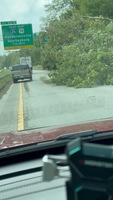 UnknownPriscilla Dunn, a Hickory, NC local and Appalachian State University Alumni had a unique Hurricane Helene story. Her son in law had an emergency surgery in Knoxville. She was coming back to Hickory from Knoxville to assist her daughter. The rivers were raging beside the roads. Then, she got stuck in a landslide on Black Mountain. She turned around to go back to Knoxville, and the Swannanoa River was 10 ft over the interstate. Pricilla stayed the night in Asheville because the police and firemen were overworked. She drove to Spartanburg the next day and then went through Charlotte to get home. She had driven the wrong way on the interstate, drove over power lines, tree branches, and swerved around them. But she also created a community for her own needs and for the needs of others.
 -
faith through the floodUnknownI am in my undergradute and my major is communication
-
A PA Student's Helene ExpirienceUnknownI interviewed Abby Murphy on her experience as a PA student in Boone NC during Hurricane Helene. I have submitted the interview audio file along with a transcript of the interview.
-
The Bay of Sugar GroveUnknownLocals look out at the astonishing flood in the valley of Sugar Grove (near Watauga Bridge). During normal times, the river meanders through a small portion of that valley and stays at about 20 feet beneath that bridge. It looks more like a bay than a river valley.
-
Jackie Mace and her story of "Chaos"UnknownInterview Summary Participants ~ Dylan Jackson, Interviewer: Public Relations and Public Health major at Appalachian State University Jackie Mace, Interviewee: VP of Market Operations at Hopscotch Primary Care in Western NC Background and Introduction ~ Jackie has lived in Appalachia for about 10 years, moving from Minnesota to Maggie Valley and currently residing in the Marshall area. She works as VP of Market Operations for Hopscotch Primary Care, managing 11 clinics across Western NC. Her husband works for Buncombe County Schools. Pre-Hurricane Community Life for Jackie ~ Jackie described her community as close-knit but initially difficult to break into as a newcomer. Moving to the area in her 40s without a local support network was challenging, but her husband's local roots helped her integrate. Before the hurricane, the community already had a strong culture of mutual support and resilience. Experience During Hurricane Helene ~ Jackie had never experienced a disaster on the scale of Hurricane Helene. The most impactful aspect of the entire situation was the human response: neighbors and colleagues supporting each other with limited resources. The Hopscotch team, including out-of-state staff, worked together to check on employees, set up temporary infrastructure (like water tanks and porta-potties), and provide essential supplies to staff and patients. Jackie shared stories of extreme generosity, like a colleague who lost everything but still helped others. Personally, Jackie and her husband were without power or water for eight days. Their neighbors and family provided what they could, and the community rallied around each other. One powerful moment for her was relying on a small battery-powered radio, her only lifeline to the outside world, for storm updates and community news. Aftermath and Reflection ~ Jackie emphasized how the experience changed her perspective on life. Material things became less important; relationships, community, and mental well-being took center stage. She noticed increased friendliness and intentionality in her community since the storm, more casual conversations, more neighborly gestures, and deeper human connection. Jackie described her overall experience with Hurricane Helene in one word: chaos, but a chaos that revealed deep human resilience and unity. Interview Key Takeaways and Themes ~ Community Resilience: Despite widespread devastation, the community came together in extraordinary ways. Organizational Response: Hopscotch Primary Care prioritized employee well-being and patient care even amidst infrastructure collapse. Personal Growth: The storm served as a turning point for Jackie, reinforcing life priorities and personal strength. Preparation Lessons: Small tools like a radio made a massive difference; the experience emphasized the importance of being prepared and flexible in crisis situations.
-
Tyden Household Hurricane Experience
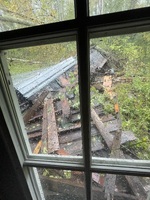 UnknownI am a graduate student who goes to Appalachian State University and who also attended undergraduate school here as well. My partner and I had lived in Zionville for almost a year at the time when the hurricane hit. We are surrounded by people who keep Boone going—not by students. Our neighbors are families, retired couples, and farmers; we are the oddballs out here. We live with our two pets, a cat and a dog. When the hurricane hit hardest, it was in the night. I remember our AC going out. We live in an old cabin with no central AC or heat—we have a wood-burning stove for heat and in-unit ACs for summer. When the AC went out, it got hot quickly. I somehow went back to bed, but then was awoken again by a giant crash. I woke my partner, and we moved ourselves and the pets downstairs to the futon. At this point, our power was fully out, and it was hot and stuffy upstairs. We all ended up falling back asleep. When it was finally daylight, we were able to see what the big crash outside the house had been. An old shed behind the house had fallen during the night, but thankfully it hadn’t fallen on us. A thin tree had also fallen onto the porch but hadn’t damaged the house. We stayed inside for most of the day until the rain let up. My partner had a satellite phone, so we were able to contact our families to let them know we were safe. A thin tree was blocking our driveway, but we ventured out with our dog anyway. We checked on our neighbors, who were on their way to check on their church, which had apparently flooded badly. Another neighbor came by, soaked head to toe, to grab a chainsaw to help someone else. Across the way, our neighbor’s farm had turned into a river, and his cows had wandered into the hills, though they were safe. A whole trailer had been torn to pieces, and cars were floating by. People sped past on dirt bikes and four-wheelers, hollering to make sure we were okay. Construction equipment from people’s farms was already on the road, trying to clear the way. Farther down the road, we came to the flower farm, which was decimated. Their farm stand was gone, and the road was destroyed. On our way back home, several people told us there was only one way out, so we listened closely and took note to remember. Luckily, our neighbor across the way was a retired lineman, and the one next to us was a current lineman, and they warned it would be a long time before power came back on. So we decided the next day we were going to hack our way out of there and try to get through in our Prius. And miraculously—we did.
 -
(none)UnknownI woke in the dark water dripping in my bedroom, no electricity, my phone blinking low battery, no one beside me. Outside, the wind howled, rain slammed the windows. Inside, silence except the water rising to my ankles. My apartment, drowning. What should I do? How do I reach someone? How do I ask for help? I opened the door the storm stared back, wild and unforgiving. I packed a few clothes, stepped into the unknown, heading to my friend’s house. The road was passable, but the world had changed. Cows once grazing now swimming. Trees, homes submerged. I lost my place. Can I return? What about my things? What about my life?
-
The Aftermath of Hurricane Helene
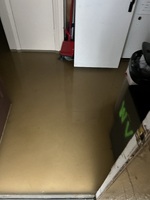 UnknownI remember Hurricane Helene very vividly. In the days leading up to the hurricane, I had no idea it was going to be as bad as it was. I hadn’t really been watching the news, and my mom kept texting me updates about the storm. Mind you, my family lives in the Wake Forest–Raleigh area. I remember telling her, “Don’t worry about me, I’ll be fine.” She would text me incessantly again, I had no idea it was going to be as bad as it was. Nobody did. I brushed it off, thinking it was just going to be a short rainstorm. But little did I know the devastation that would follow. The night before, I didn’t think to get bottled water, non-perishables, or anything like that. All I had bought was toilet paper. I was ignorant. As anxious a person as I am, I’m usually much better at planning for the worst. This time, I wasn’t. And this time, I dealt with the consequences. The morning of September 27, my roommate and I woke up to a flooded basement. Our power had gone out. We were without food, water, or electricity. At that point, we began collecting rainwater just to have something to drink. We couldn’t call or text our families. We were completely disconnected from everyone, just the two of us, waiting for the storm to blow over. Around 4 p.m., the rain finally stopped. My roommate and I went outside to assess the damage. To the right of our house, the road above ours had collapsed, causing a major landslide that spilled into the middle of our street, blocking us in. The basement of a house below ours had flooded about five feet. The students living there had to break a window to let the water escape. Looking in the other direction, to the left of our house, a power line hung dangerously in the middle of the street. The wind had knocked over a tree, which had landed right on it. After seeing all the destruction Hurricane Helene had caused, my roommate and I began trying to clear the road so we could leave the neighborhood in search of food and water. A few of our neighbors were doing the same. As we tried to clear debris from under our car with a snow shovel, a college student from across the street approached us, asking for help. The poor guy looked pale, was shivering, clearly hungry, and dehydrated. He said he didn’t live at the house and that he was just staying with his buddies. They had no food or water, and he asked us for a ride. His car had been completely demolished. Debris, including a ping pong table, had been lodged underneath it. He couldn’t get out. His car had been parked at the house with five feet of flooding in the basement, so I could only imagine what it looked like. My roommates and I were fortunate to have only five inches of flooding. We lived in a duplex on a hill my roommate and I lived upstairs, and our two other roommates (two guys) lived on the bottom floor. Eventually, we cleared the debris from beneath our car and went in search of any places that might be open. Once we saw that there was power on campus, we stopped at The Market. Sheetz was open too, so that became our second stop, before taking the guy we helped back home. The next day, not knowing when our power would be back, I packed my things and left to stay with my family for the next few weeks.
 -
Blairmont LakeUnknownThe experience was truly wild. Being located above the floodplain and the greenway as well as right next to the hospital I often figured the storm would kind of pass us over. The storm never fully picked up until the morning of Thursday. When I woke up the water had risen another 10 feet nearly. It had to have been well over 20 feet from the floodplain. During the storm I was able to witness countless cars going by, gazebo’s, trees and so forth. It truly put the storm into perspective. I consider myself extremely fortunate to be in the area that I was in. As flat and open as the golf course was allowed the water to pass us over without decimating bridges, homes and other larger structures. The water had a way to go. I remember the water coming up over barns and well over the tops of road signs. It was also wild that no one else could have experienced what I did in that area. Everyone had a different view and situation. Standing by helpless watching everything pass was painful. Quickly after the store I remember checking on the houses close by and in the flood zone. The water and mud did not leave for months. The power lines remained across the road for up to two weeks. Being so close to the hospital I figured we would receive power quickly but it was out for a few weeks. Despite the storm I have never felt closer to my neighbors and to my community. It truly opened my eyes. Additionally going to Spruce Pine a week after to deliver supplies it blew my mind even more. There were steel I beams for factories or warehouses that were twisted like a bread tied around a 50 ft bridge, the water had come well over the top. Seeing the place that I had spent so much time visiting receiving it considerably worse than myself was hard. A bit of survivors guilt. The same for the Watuaga river past valle crucis. The flood plains truly saved my life and those around the main rivers were not so fortunate. It was heartbreaking. The video was used by some students down the mountain in Charlotte and Winston for school newspapers as the view was so alarming. It put the amount of water into perspective. I cannot imagine having being on a bend or river location.
-
Apartment Destruction
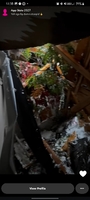 UnknownAt 5am on the day the hurricane first hit Boone, I felt my building shake as if an earthquake had struck. The noise was so loud I thought a bomb had gone off. A massive oak tree had completely destroyed half our apartment building, and we ran out of our room as we were hearing screaming coming from where the tree had struck. I pulled out guys from one of the apartments, and I saw that part of the tree had skewered through his bed. He was unharmed, which was a miracle from God. I will never forget that day.
 -
Interview of Caleb Hignite - BRAHM listening day - Sept 20, 2025UnknownThis interview captures the powerful story of Caleb Hignite, a folk musician and ethnomusicologist who transformed his deep connection to Appalachian culture into a mission of documentation and advocacy following Hurricane Helene. From his roots in folk music and banjo playing to his extensive photographic documentation of the storm's aftermath, Hignite shares his experiences of witnessing devastation in rural communities like Mitchell County's Green Mountain and Red Hill. The conversation explores how traditional music provided solace during recovery, his work with the Appalachian Reclamation Alliance, and his belief that we are currently experiencing the fourth major folk revival movement in American history—one born from societal tensions and the need for authentic cultural connection.
-
Interview of Heather Higgins - Hurricane Helene Listening Day in the High Country - Sept 20, 2025UnknownAudio from BRAHM - Hurricane Helene Listening Day in the High Country Heather Higgins a resident of western Watauga County, shares her deeply personal account of Hurricane Helene's impact on her life and community. Living alone in a working-class area, Heather was dealing with her dying dog when neighbors gave her just 30 minutes to evacuate before roads became impassable. Her story captures the complex emotions of survival—from initial gratitude for being spared major damage to guilt over her neighbors' greater losses, and the lasting depression that followed. The interview reveals the uneven distribution of disaster impact within communities and the psychological toll of witnessing widespread destruction. Heather's experience highlights the isolation many felt when outside help was slow to arrive, leaving communities to rely entirely on each other. The centerpiece of her testimony is a haunting journal entry she wrote months after the storm, a poetic reflection on how the disaster transformed both the physical landscape and her emotional connection to the mountains she calls home. Her words capture the lasting trauma of watching "beauty buried beneath the rubble" and the ongoing struggle to process profound change in a place that once provided spiritual sustenance.
-
Helene in Southern Appalachian Story Map
 UnknownThis story map was created by NOAA and contains lots of images, data and narrative about the impacts of Helene in our region.
 -
Interview of Annie WillisUnknownAnnie and a few others from Boone United Methodist Church went to a cleanup 09/13/2025. I interviewed Annie one year post-hurricane to see what emotions the cleanup brought back.
-
Bethel aftermath
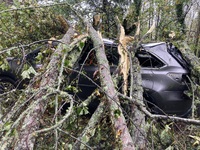 UnknownPhotos from the Bethel area near the NC/TN boarder in the days after the storm.
 -
Doc Watson
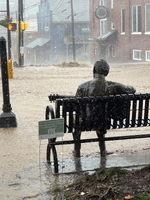 UnknownI live in downtown Boone and after a tree came down on my property, cutting off power and leaving me wondering when the next tree might fall, I decided to put on all of my rain gear and walk downtown. I walked where I could for about an hour taking pictures and video and checking on friends' businesses. As I was heading home at about 11:30 am, the rain picked up heavily again and I decided to take cover under an awning just behind the Doc Watson statue on King St. From that perspective I took a picture of Doc, playing his guitar as the floodwaters poured through the intersection of King and Depot streets.
 -
From flood to reliefUnknownI am currently enrolled at Appalachian State University and My apartment that I was living in is located right next to the Walmart in Boone. The first floor got completely flooded, the water inside my apartment reach above the feet in depth. My roommate and myself were able to save some of our valuables such as computers and our cars but most of possessions where lost. I am enlisted in the air national guard as a c 17 loadmaster and when I got the notification that we were being called to deliver supply’s to Asheville I took it. In a matter of 3 days I went from having my apartment flooded to delivering over 100,000lbs of hurricane relief supplies
-
How the community's support inspired me
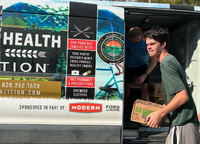 UnknownWhile I was fortunate not to suffer personal losses during the storm that swept through our town, the widespread destruction I witnessed left a profound impact on me. Houses were damaged, trees lay scattered like sticks, and the streets were filled with lives disrupted. My connection to the local community deepened as I actively engaged in outreach and volunteered my time to support those in need before the storm. For several days, I wrestled with an overwhelming sadness resulting from the devastation, reflecting on its impact on our neighbors, friends, and our community. Despite the despair that hung in the air, I felt a powerful urge to restore hope and positivity to Boone. I drew strength from my relationships with local organizations and community members who shared a common goal of recovery and resilience. Eager to make a difference, I initially looked to volunteer with multiple organizations, but I encountered significant barriers. Finding volunteer applications online proved to be a difficult task, and unanswered phone calls added to my sense of urgency and determination. Despite these obstacles, I pressed on with my mission to assist those in need. Over time, it became evident that many organizations were overwhelmed with requests for help, making it clear that non profits were overwhelmed at the moment. Recognizing the importance of self-care during this journey, I took a brief respite at my dad's house on the other side of the state to recharge both physically and mentally. At the time of the hurricane, I served as the service chair for the National Residence Hall Honorary (NRHH) at Appalachian State University, an organization devoted to enabling leadership, recognition, and service within our campus community. While the storm temporarily halted our scheduled activities, I took hold of the opportunity to resurrect our organization as Boone began to recover. I worked diligently to organize a volunteer day with Samaritan's Purse, a well respected nonprofit focused on disaster relief efforts. This not only breathed new life into our organization but also revitalized a sense of hope within the local community. On that impactful day, we united as a group to clear fallen tree trunks and debris from a resident's yard, embracing the spirit of teamwork and collaboration. I recalled how satisfying it felt to see smiles return to the faces of residents as we worked side by side with them. Prior to my work with NRHH, I had already volunteered with Samaritan's Purse just two weeks after the storm, helping to distribute vital relief supplies and support families wrestling with the aftermath. My efforts included dedicating time to Anna Bananas, where I folded clothing for those in need, ensuring that each item was prepared with care. At Hunger and Health, I cleaned prescription bottles and sorted meal packages for local families, ensuring that those who were struggling received the food they required. Additionally, I worked at the Green Valley Community Park in Todd, assisting in cleaning trails to remove unwanted debris, allowing that space to be restored for community enjoyment. The unwavering spirit of the community surrounding me, even in their struggles, fueled my desire to conduct more service. As a result, my commitment to service continues to thrive today, driven by the connections I’ve cultivated, whether I’m organizing campus clean-ups or crafting blankets for patients at our local medical center. Through these diverse efforts, I aim to develop a spirit of community and resilience, ensuring that we emerge stronger together in our ongoing recovery journey.